Traditional Market vs Digital Market
Traditional marketing refers to conventional methods of promotion that have been used for decades. Digital marketing uses online platforms and technologies to promote products and services.
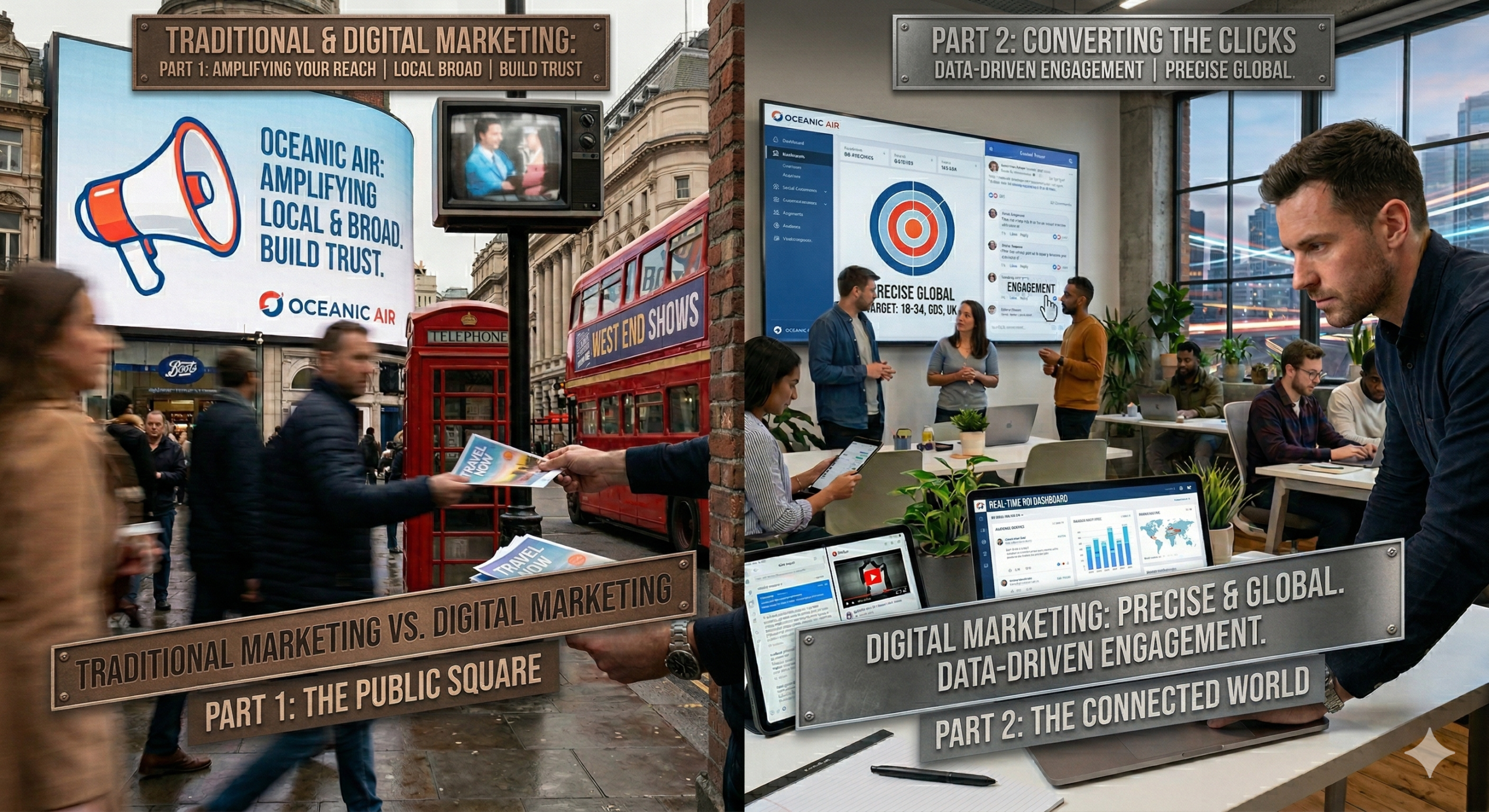
Traditional Marketing:
Traditional marketing refers to conventional methods of promotion that have been used for decades. These include:
- Television and radio advertisements
- Newspaper and magazine ads
- Billboards and hoardings
- Flyers, brochures, and direct mail
- Telemarketing
These methods rely heavily on offline channels and are often designed to reach a broad audience.
Advantages of Traditional Marketing
Traditional marketing still holds value, especially in certain contexts:
- Wide reach: Ideal for mass audiences, especially in rural or less digitally connected areas
- Credibility: Print media and TV ads are often perceived as more trustworthy
- Tangible materials: Physical brochures or flyers can leave a lasting impression
Limitations of Traditional Marketing
Despite its strengths, traditional marketing has several drawbacks:
- High cost: TV ads and print campaigns can be expensive
- Limited targeting: Hard to focus on specific customer segments
- Difficult to measure: Tracking ROI (Return on Investment) is challenging
Digital Marketing:
Digital marketing uses online platforms and technologies to promote products and services. It includes:
- Social media marketing (Facebook, Instagram, LinkedIn)
- Search engine optimization (SEO)
- Email marketing
- Content marketing (blogs, videos)
- Pay-per-click (PPC) advertising
This approach leverages the internet to connect with audiences in a more personalized and interactive way.
Advantages of Digital Marketing :
Digital marketing has rapidly gained popularity due to its flexibility and efficiency:
- Cost-effective: Suitable for businesses of all sizes
- Targeted audience: Ads can be customized based on age, location, interests, and behavior
- Measurable results: Real-time analytics help track performance
- Global reach: Businesses can connect with customers worldwide
- Engagement: Two-way communication through comments, messages, and reviews
Limitations of Digital Marketing –
While powerful, digital marketing is not without challenges:
- Internet dependency: Requires users to be online
- High competition: Saturated digital space makes visibility harder
- Constant updates: Algorithms and trends change frequently
Key Differences Between Traditional and Digital Marketing
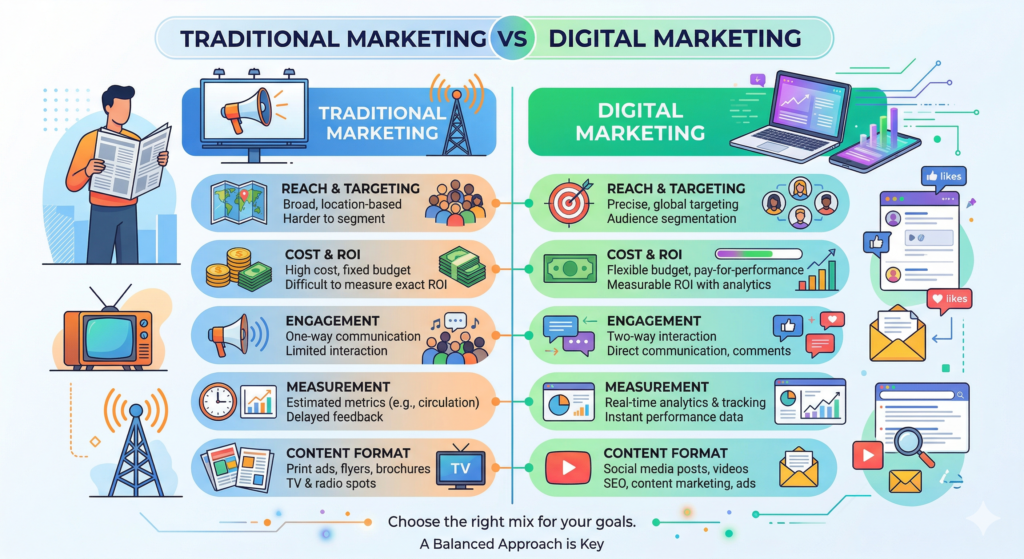
| Aspect | Traditional Marketin0g | Digital Marketing |
| Medium | Offline | Online |
| Cost | High | Generally lower |
| Audience Targeting | Broad | Highly specific |
| Interaction | One-way communication | Two-way communication |
| Measurability | Difficult | Easy with analytics tools |
| Flexibility | Less flexible | Highly adaptable |
Which One is Better:-
There is no one-size-fits-all answer. The choice depends on:
- Business goals
- Target audience
- Budget
- Industry type
Best Possible Way is:-
In many cases, a hybrid approach works best. For example, a company might use billboards for brand awareness while simultaneously running social media campaigns for engagement.
ट्रेडिशनल और डिजिटल मार्केटिंग में मुख्य अंतर माध्यम और पहुँच का है। ट्रेडिशनल मार्केटिंग (टीवी, प्रिंट) ऑफलाइन, व्यापक दर्शकों के लिए होती है, जबकि डिजिटल मार्केटिंग (सोशल मीडिया, एसईओ) ऑनलाइन, लक्षित दर्शकों के लिए है। डिजिटल मार्केटिंग सस्ती, मापन योग्य (measurable) और तत्काल प्रतिक्रिया देने वाली है। BYJU’S +4
पारंपरिक मार्केटिंग (Traditional Marketing)
- माध्यम: समाचार पत्र, पत्रिकाएं, बिलबोर्ड, टीवी, रेडियो, पम्फलेट।
- फायदे: स्थानीय लोगों तक पहुँच आसान, ब्रांड की विश्वसनीयता।
- नुकसान: महंगा, परिणाम मापना मुश्किल, दर्शकों से सीधा संवाद नहीं।
डिजिटल मार्केटिंग (Digital Marketing)
- माध्यम: सोशल मीडिया, वेबसाइट, ईमेल, सर्च इंजन (SEO), YouTube।
- फायदे: कम लागत, सटीक टारगेट ऑडियंस, तुरंत परिणाम (ROI) ट्रैकिंग, वैश्विक पहुँच।
- नुकसान: तकनीक पर निर्भरता, लगातार अपडेट की आवश्यकता।
Testbook +4
मुख्य अंतर तालिका (Key Differences):
| विशेषता | पारंपरिक मार्केटिंग | डिजिटल मार्केटिंग |
|---|---|---|
| पहुँच | स्थानीय/व्यापक (Broad) | वैश्विक/लक्षित (Targeted) |
| लागत | उच्च (High) | कम/फ्लेक्सिबल (Low) |
| परिणाम | मापना मुश्किल | तुरंत ट्रैकिंग (Analytics) |
| संवाद | एकतरफा (One-way) | दो-तरफा (Interactive) |
| गति | धीमी (Slow) | तत्काल (Instant) |
निष्कर्ष:
बड़े ब्रांड्स के लिए दोनों का मिश्रण सबसे प्रभावी है, लेकिन छोटे बजट और सटीक ग्राहकों के लिए डिजिटल मार्केटिंग बेहतर विकल्प है।